Garden Edging Ideas: Materials and Layout for Neat Backyard Beds
Garden edging has two jobs, and only one of them is about looks. It holds mulch and soil inside the bed, and it stops lawn runners getting out. Pick your material for the second job, because that is the one that fails first. A bed edged with something a kikuyu runner can walk straight over will look sharp for a season and then need rescuing every spring.
Heads up: one link below goes to a product on Amazon, and we may earn a small commission if you buy through it, at no extra cost to you. We only point at gear we would genuinely use.
Steel edging
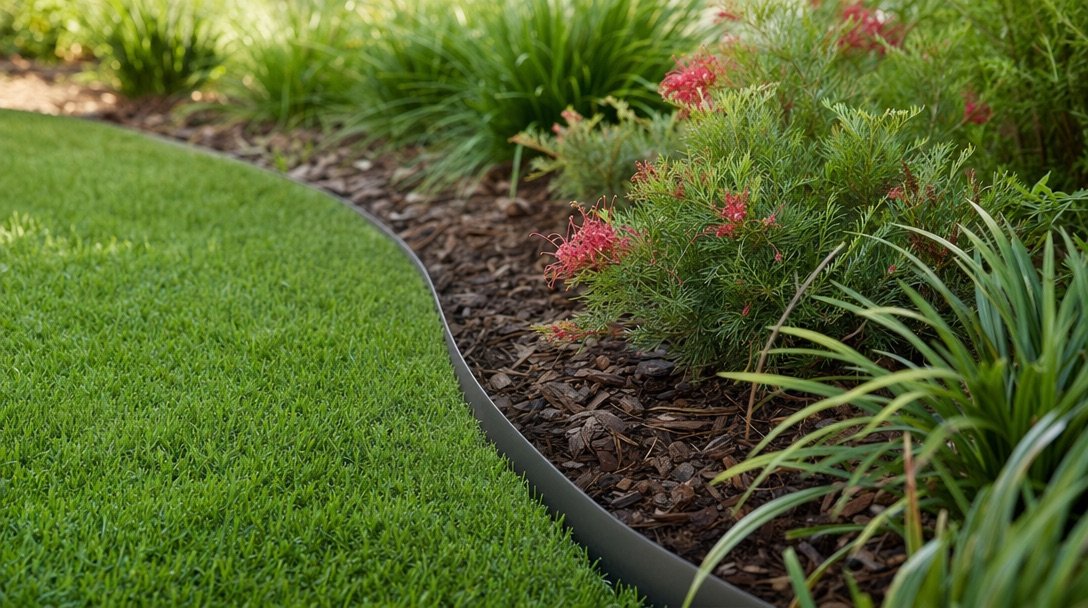
Steel is what most landscapers reach for when the client wants curves. It bends to a smooth radius without kinking, it sits low and disappears visually, and once it is pegged properly it does not move.
You will see it sold in a few forms:
- Galvanised or aluminium-zinc alloy coated steel: silver at first, dulls off to grey over a year or two.
- Corten or weathering steel: rusts to a stable orange-brown patina on purpose. Looks great against natives and grasses, costs more.
- Powder-coated aluminium: lighter, will not rust at all, softer underfoot to work with. Bends easily, dents easily too.
Corten comes as fixed panels and as long flexible rolls. For a curved bed a 20 metre Corten steel edging roll is the format to look at, because you set the whole arc out in one piece instead of joining short panels around it.
The catch with steel is the top edge. A thin gauge strip standing proud of the lawn is unpleasant to kneel on and can catch a mower wheel. Set it flush or nearly flush and the problem disappears.
Timber edging
Treated pine sleepers and hardwood sleepers give you a solid, wide, rectilinear edge. If your beds are straight-sided and you want something you can sit on, timber is the honest answer.
It does not do curves. You can step a sleeper edge around a gentle arc in short segments, but you will see every joint. Timber also has a service life in the ground, and that life is shorter in the wet subtropics than it is in Adelaide or Perth. Hardwood outlasts treated pine, and both outlast untreated anything.
Two things worth doing: pin each sleeper with galvanised stakes on the bed side, not the lawn side, and leave a couple of millimetres between the ends of butted sleepers so they can move without pushing each other out of line.
Brick, paver and concrete edging
A mowing strip is the version of this that earns its keep. That is a row of bricks or pavers laid flat on a bedding of compacted road base, sitting level with the lawn, wide enough that the mower wheel can run along it. You mow right over the edge, no whipper snipper, no scalping.
Laid on edge or on a soldier course it looks smart but you have given up the mowing strip advantage. Laid straight onto soil with nothing under it, it will sink and wander within a couple of seasons. The bedding is the whole job.
Plastic and poly edging
The flexible black poly roll from the hardware store is cheap, and it will hold a curve. It is fine around a small ornamental bed or a bit of temporary shaping.
It is not fine as a permanent boundary against a vigorous lawn. It works loose, lifts at the joins, and once the top lip is exposed it goes brittle in the UV. If you are edging a bed against couch or kikuyu and you want to stop thinking about it, spend the extra on steel.
Setting the line out
Do this before you dig anything.
For a straight run, two pegs and a stringline. Pull the string tight, stand back, look at it from the house and from wherever people actually walk. Move it if it is not right. String is cheap, relaying an edge is not.
For a curve, lay the garden hose out on the lawn and shape it by eye. Leave it there overnight and look at it in the morning with fresh eyes. A curve that looks good from the back door often looks wrong from the side gate. Once you are happy, mark the line with a dusting of lime or line marking paint and pick the hose up.
Keep curves generous. Tight little wiggles are hard to mow around and hard to bend steel into, and they never look as good built as they did drawn on the lawn.
Height, and why most edges fail
The edge should finish level with the lawn surface or a whisker below it, and stand proud on the bed side.
That gives you a mulch well. Fill the bed to roughly 75mm of mulch and keep it 30 or 40mm below the top of the edge, and the mulch stays in the bed through heavy rain instead of washing across the lawn. It also lets the mower pass over the edge without hitting it.
An edge that stands 50mm above the lawn does the opposite. It catches the mower, it collects clippings, and grass grows up against the face of it where you cannot get at it.
Stopping couch and kikuyu
Neither of them respects a surface edge. Couch travels on runners just under the soil and kikuyu will go deeper. If they are your lawn, the edge needs depth.
Steel buried 100mm or more into the soil stops most of it. A shallow strip that only sits in the top of the turf stops none of it. Timber sleepers sitting on the surface stop nothing either, unless you dig them in.
Even with a deep edge, expect to walk the line once or twice a season with a spade or a half-moon edger and cut back the runners that have gone over the top. That is normal maintenance, not a sign the edge has failed. Ten minutes a bed, a couple of times a year, and the whole yard reads as tidy.
Buffalo is easier. It spreads on above-ground stolons, so a properly set edge with a mulch well genuinely does hold it.