Trees, Roots and Backyard Works: What to Sort Before You Build or Dig
Before you dig, pour or build anywhere near an established tree, three things need sorting: what is buried under the ground, whether that tree is protected where you live, and how much root zone it needs to survive the works. Answer those first and the rest is ordinary building. Skip them and you get a cracked slab, a blocked sewer, a dying tree or a fine.
What an established tree does to your plans
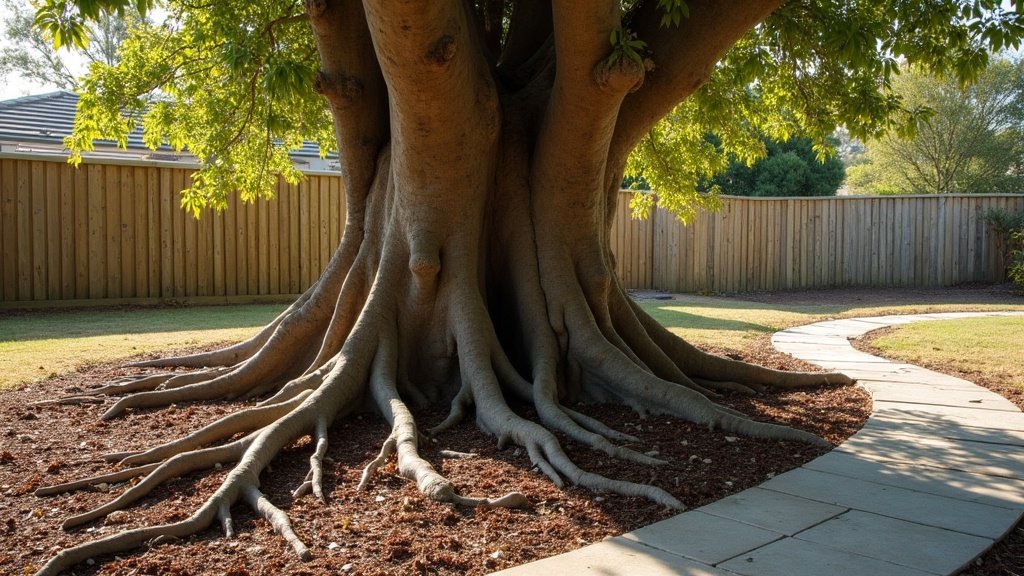
Most people picture roots as a mirror image of the canopy, driving straight down. They do not. The fine feeding roots sit in the top layer of soil where the water and the air are, and they spread well past the edge of the branches. A tree that looks a comfortable distance from the house can still be sitting under your proposed deck.
The trunk is easy to design around. The root plate is what gets missed, and it is what holds the tree upright. Cut enough of it on one side and you have changed how that tree handles a strong wind.
Know what is under the ground before the first shovel
Roots are not the only thing down there. Water, gas, power, comms and sewer can all run through a suburban backyard, and older properties are full of private lines nobody documented.
- Lodge a Before You Dig Australia enquiry: it is free, it takes minutes online, and asset owners send you plans of their registered underground networks.
- Treat those plans as a guide: they cover registered assets and approximate positions, not the water line someone ran to the shed in 1988.
- Pothole by hand near anything marked: hand digging or a vacuum excavator around services is slow, and still cheaper than clipping a gas main.
- Mark the tree out too: paint or peg the root zone so the machine operator can see it on the day, not just on a drawing.
Overhanging limbs and what you can actually touch
Branches hanging over the fence from next door is the most common question here, and the honest answer is that it depends on your state, your council, and whether that tree is protected. Some pruning you can just organise. Some you cannot touch without approval, even where the limb is clearly over your side. Ring your council before the saw comes out, and talk to the neighbour first.
Two things are worth doing either way. Get dead or hanging limbs assessed, because those are the ones that come down in a summer storm. And never let anyone top a tree to win back light, because the regrowth comes back weaker.
Roots near paving, footings and drains
Roots do not attack concrete out of spite. They follow moisture and soft ground. Pavers lift because a root found the loose bedding sand underneath. Drains block because roots found water escaping from a bad joint or a crack in an old earthenware line.
- Favour flexible surfaces near trees: sand set pavers or decking on piers can be lifted and relaid, whereas a slab has to be broken out.
- Keep new footings out of the root zone: shifting a post a metre is free at the drawing stage and painful once plans are approved.
- Repair the pipe, not just the root: cutting roots out of a drain and leaving the crack books you the same job next season.
- Get advice before installing a root barrier: at the wrong depth or offset it achieves little and can destabilise the tree.
If the surface around the tree is more tired than damaged, our guide to cleaning outdoor tiles and pavers covers that without the excavator.
Protected trees and council approval
Councils around Australia regulate the pruning and removal of trees, and the rules change from one local government area to the next. Some protect trees over a certain size, some keep a register of significant trees, some tie tree works to your planning approval. Getting it wrong lands on the property owner, not on whoever swung the saw.
So ask your own council before you commit to a design that depends on a tree being gone. Find out what applies at your address, what the exemptions are, and whether the works need an arborist report with the application.
Worth knowing: there is an Australian Standard covering the protection of trees on development sites, AS 4970, published by Standards Australia, and councils commonly lean on it. It sets out a tree protection zone that works stay out of, and your arborist calculates that zone for your tree.
Why a qualified arborist beats a bloke with a chainsaw
There is a real gap between lopping and arboriculture. Assessing tree health, mapping the root zone, judging what can be pruned without wrecking the structure and writing a report a council will accept is specialist work for qualified arborists such as Waratah Professional Tree Care. Pruning of amenity trees has its own standard as well, AS 4373, and a qualified arborist works to it.
When quotes come in, ask what arboricultural qualification the person holds, whether they carry public liability and workers cover, and how they intend to prune. If the answer is that they will take the top out of it, keep looking.
Building around a tree so it survives
Trees rarely die during a build. They die eighteen months later, once everyone has forgotten the cause. Fence off the protection zone before machinery arrives and leave it up until the last trade goes home. Keep materials out from under the canopy, and never wash out concrete near the root zone.
Compaction is the damage you cannot see. A ute parked under the canopy for a fortnight squeezes the air out of the soil and the roots suffocate quietly. Soak the tree through the dry stretches of the build, mulch the root zone, and have the arborist back a year after handover. Sorting this at the start, alongside the rest of your backyard planning, costs an afternoon. Fixing it afterwards costs you the tree.