Making a Small Courtyard Feel Bigger: Layout, Levels and Plant Choice
A small courtyard feels bigger when your eye has somewhere to travel and nothing to trip over on the way. That comes down to four things: a change of level, seating that’s built in rather than dragged in, planting that climbs instead of spreads, and no more than two or three materials. Get those right and a 4 by 5 metre townhouse yard reads as a room, not a leftover strip behind the laundry.
Most tight yards go wrong the same way: a full-size outdoor setting, a fence line of mismatched pots, and a third paver colour by the gate. Each choice is fine alone. Together they chop the space into bits.
Use a change of level to define zones
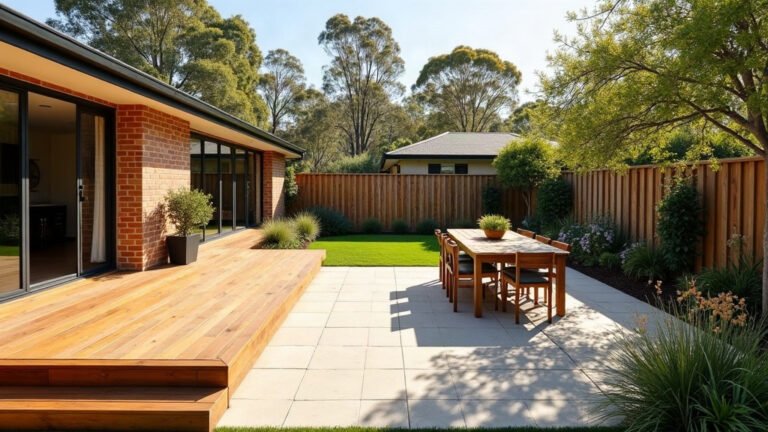
A change of level splits one flat rectangle into two defined zones, each with its own job. A single step does it. Drop a dining area one step below a small deck, or lift a planter bed to seat height along one side, and the yard suddenly has an upstairs and a downstairs.
The trick is to keep each level generous. Make the upper level wide enough for a chair to push back without the legs going over the edge. If you’re weighing up timber against pavers for that upper level, our pavers vs decking guide covers how each one copes with a slope.
One rule to know before you build up: the National Construction Code requires a barrier where it’s possible to fall 1 metre or more to the surface below. If your design gets anywhere near that height, talk to your council or a building certifier before the timber arrives.
Built-in seating usually beats a dining setting
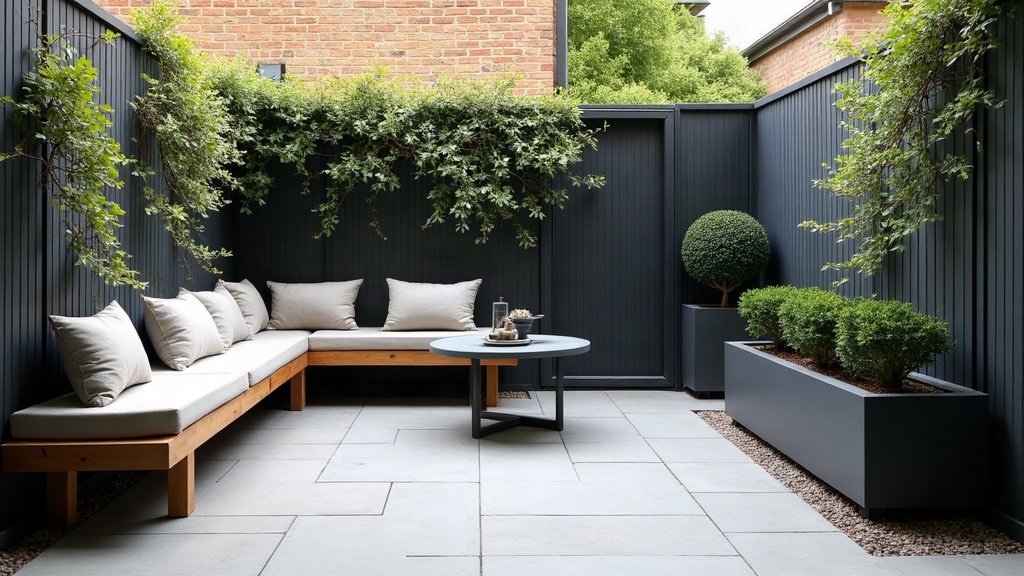
A loose table and six chairs eats a small courtyard alive. You need the floor space for the furniture, plus about 700 mm behind each chair to get in and out. Built-in bench seating along a wall or the edge of a raised bed gives you bums on seats without chairs to push back, and the clear floor in the middle does the visual work.
A few things that make built-in seats actually comfortable:
- Seat height: aim for about 450 mm, the same as a normal chair, so people aren’t perched or squatting.
- Depth: 450 to 500 mm with a slight backward lean, or add outdoor cushions against the wall.
- Storage underneath: a lift-up lid swallows cushions, the hose and kids’ toys, which keeps the floor clear.
Pair the bench with one small round table, which has no corners to walk into. For cushion fabrics that won’t go mouldy in a shaded courtyard, see our guide to outdoor furniture that survives the Australian climate.
Do mirrors really work outside?
They can, if you place them carefully. A mirror on the back fence, framed like a window or set behind an arch of climbers, makes the garden look like it carries on through the wall. Use outdoor-rated acrylic mirror or a sealed glass mirror made for exterior use. Indoor mirrors tend to lose their silvering at the edges outdoors.
Two cautions. Birds can fly into a mirror that reflects sky and greenery, so think twice about one in a yard that gets a lot of bird traffic. And keep mirrors off any wall that cops the afternoon western sun, because the glare bounces straight back at the house and the people sitting in the courtyard.
Grow up, not out
Floor space is the scarce thing in a courtyard, so the planting should go vertical. Climbers on wire trellis, a pleached or columnar tree, and wall-hung planters all give you green at eye level without stealing ground. Star jasmine on stainless wires gives a flat, glossy screen that stays thin.
We’ve covered the systems in detail in our vertical gardens and green walls guide. If neighbours look straight into your courtyard, our privacy screening ideas cover slatted panels, lattice and other screens that block the view.
Limit the palette to two or three materials
Pick one floor material, one wall or fence finish, and one accent, such as timber for the bench, and stop there. Run the floor material right to the fence lines rather than leaving a border of soil or a different stone. Unbroken flooring makes the eye read the full width.
Colour works the same way. Dark charcoal or deep green fences let the plants in front of them stand out.
Choose plants that stay in scale
The plant that looks perfect in a 200 mm pot at the nursery can be three metres wide in five years. In a courtyard, check the mature size on the label before anything else. A few that behave well in tight spaces:
- Westringia ‘Grey Box’: a compact native that clips into a neat low ball or hedge.
- Dwarf lilly pilly cultivars: good for a clipped screen in a large pot or narrow bed.
- Japanese maple in a pot: one feature tree for a shaded corner, with autumn colour.
- Dianella and lomandra: strappy foliage that softens edges and copes with dry spells.
Fewer, bigger pots usually look better than lots of little ones. Three large matching pots look deliberate, and bigger pots dry out more slowly in summer. If you want herbs or veggies in the mix, a single raised garden bed that doubles as seating edge earns its space twice.
Light it so it reads at night
Uplight the one feature tree and wash a little warm white light down the back fence, so the far boundary still reads after dark. Our outdoor and garden lighting guide covers fittings and placement.