Espalier and Dwarf Fruit Trees: Growing Fruit in a Small Backyard
A fruit tree doesn’t need a paddock. An apple or pear can be trained flat against a fence, and a dwarf lemon will crop in a pot on the patio. The catch is upkeep. Espalier swaps space for pruning time, and potted dwarf trees swap it for watering.
Espalier is a tree grown flat on wires
Espalier means training a tree’s branches along a flat frame, usually horizontal wires fixed to a fence or wall. You tie young shoots to the wires while they still bend, and you cut off whatever grows out towards you. The classic shape is a central trunk with matching horizontal arms in tiers. A fan, with branches spread like the ribs of a hand fan, is the other common one.
Pick the sunniest run of fence you have. The Royal Horticultural Society’s guide to starting an espalier sets the horizontal wires 35 to 45 cm apart and at least 10 cm off the wall or fence, so air can move behind the leaves.
If the fence is a shared boundary, talk to the neighbour before you drill into it, or set your own posts just inside the line.
Some fruit suits a fence better than others
Apples and pears are the easiest trees to train into formal tiers. Pick a spur-bearing variety, which fruits on short, stubby spurs that keep producing for years, so the framework you build stays put. Tip-bearing varieties are harder to train, so check the label. Peaches and nectarines fruit on shoots that grew the season before, so some wood has to be replaced every year. A fan gives you room to do that. Citrus and figs don’t take to strict tiers, but both can be tied back loosely against a warm wall.
| Fruit | Best trained shape | Needs a pollination partner? |
|---|---|---|
| Apple | Horizontal tiers | Usually yes |
| Pear | Horizontal tiers | Usually yes |
| Peach and nectarine | Fan | No, most are self-fertile |
| Plum | Fan | Depends on the variety |
| Sweet cherry | Fan | Often yes |
| Citrus | Loose fan | No |
| Fig | Loose fan | No |
Pollination decides how many trees you need
The nursery label tells you whether a variety is self-fertile. If it isn’t, it needs a second variety nearby that flowers at the same time. In a small yard you’ve got three ways to get one:
- A second espalier: plant a compatible variety further along the same fence.
- A multi-grafted tree: two or more varieties share one trunk and pollinate each other.
- A neighbour’s tree: a compatible apple or crabapple over the fence can do the job.
Bees carry the pollen, so it helps to keep the yard friendly to pollinators and hold off spraying while trees are in flower. Climate matters too. Apples, pears and cherries need a cold winter to flower well, so in warm coastal and subtropical areas ask the nursery for low-chill varieties.
Dwarf trees do the same job in a pot
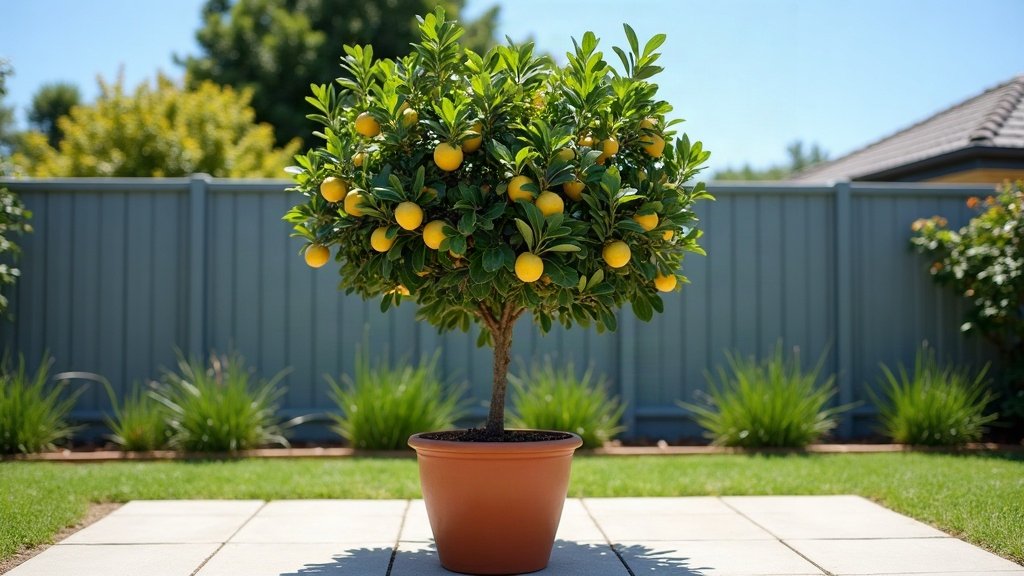
Many dwarf fruit trees are ordinary varieties grafted onto a rootstock that keeps the tree small. The fruit is full size. They need no training beyond a light tidy, which makes them the low-effort choice for a patio or a small courtyard. Citrus is the standout in pots, and dwarf apples, peaches and nectarines are sold as well. “Dwarf” isn’t a fixed size, so read the mature height on the label before you buy.
The trade-off is water. A tree in a pot can’t send roots looking for moisture, and a pot in full sun dries out quickly in summer. Our guide to pot size, potting mix and summer watering covers the setup.
What the commitment looks like, year by year
- Year one: plant in winter, when bare-root trees go in. Cut the young tree back to just above the first wire, then tie the two best side shoots along it as the first tier and leave the central stem to grow on.
- Years two to four: prune the central stem each winter to produce the next pair of arms, about one tier a year. Expect little or no fruit while the tree is building its frame.
- After that: the frame is finished and the job becomes summer pruning. You cut the season’s new side shoots back to a few leaves so the spurs stay short.
Summer is the main pruning season because cutting then slows a tree down, while winter cuts push it to grow harder. Stone fruit is best pruned in dry weather after harvest, since wet cuts are an easy way in for disease. Leave it unpruned and the tree eventually heads back towards its natural shape.
Netting a flat tree without harming wildlife
A flat tree is easy to net, which helps once birds and possums find the fruit. In Victoria the mesh size is set by law. Household fruit netting must be no bigger than 5 mm by 5 mm, and it has been illegal to use or sell larger mesh since 1 September 2021, according to the Victorian Government. Larger mesh is more likely to entangle birds, bats and possums. Bird netting also won’t stop fruit fly. That takes insect-exclusion mesh or bags over the fruit.
If you’ll keep up the summer pruning, espalier an apple or pear on your sunniest fence. If you won’t, buy a dwarf citrus and a big pot.