Creating a Chill-Out Corner: Hammocks, Daybeds and Hanging Chairs
Pick a hammock if you want to nap, a daybed if you want to stretch out with a book for an afternoon, and a hanging egg chair if your space is tight and you mostly sit. Then spend more thought on what holds it up than on the seat itself.
The other half of the job is location. A quiet corner only works if it is actually quiet, shaded at the time of day you will use it, and far enough from the barbecue that nobody walks through it with a plate of snags.
Hammock, daybed or hanging chair: which suits your yard?
Each one asks something different of the space. Before buying, measure the spot and think about how you will really use it on a Sunday afternoon.
- Hammock: the cheapest way to get horizontal, and the one that needs the most room. A rope or fabric hammock needs two anchor points a good distance apart plus enough sag that you sit in it rather than on top of it. Spreader bar hammocks look neat but tip more easily. Gathered end ones cradle you and feel more secure.
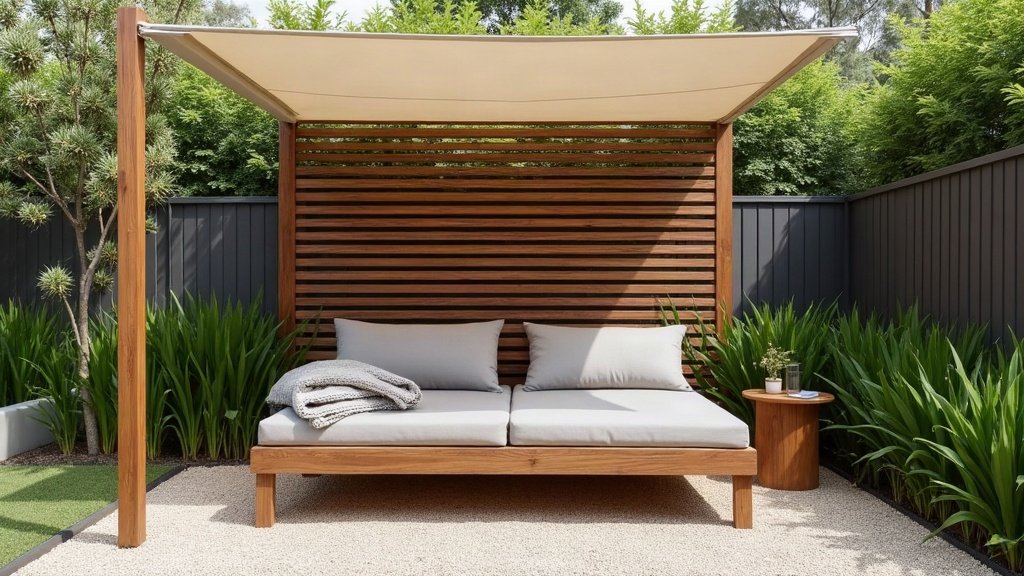
- Daybed: the most comfortable for long stretches and the easiest for two people. It sits on the ground, so there is no anchoring to worry about, but it takes a big flat footprint and the cushions need somewhere dry to live when it rains.
- Hanging egg or swing chair: the best fit for small courtyards and balconies. Most come with a freestanding stand, which takes the guesswork out of hanging. Leave clearance all round for the swing, and set the stand on level, firm ground so it does not walk.
If you are working with a narrow side area or a courtyard, a chair usually wins. There are more layout ideas in our small courtyard design guide.
What can you safely hang a hammock or chair from?
Hang it from something designed or checked for a moving load: a purpose-built hammock or chair stand, or solid posts set in concrete with hardware rated for hanging seats. That is the short answer.
A person in a hammock does not just press down. Every time you climb in, roll over or swing, the load jerks and pulls sideways on the anchor. Things that hold up a static weight happily can loosen or crack under that.
Pergola beams
A pergola is usually built to carry its own roof or shade cloth, not a swinging adult pulling on one rafter. Some are strong enough and plenty are not, and you cannot tell by looking. Ask the builder who put it up, or get a builder or engineer to check it, before you bolt anything on. If you are still planning the structure, say so at the design stage so the right beam goes in. Our pergola, patio and verandah comparison covers the bigger choice.
Trees
A healthy, mature tree with a thick trunk can work. A tree with dead limbs, cracks, lean or fungus at the base is a hard no. Use wide tree straps rather than thin rope or screw-in hooks, because rope bites into bark and hooks wound the trunk. If you are not sure the tree is sound, get an arborist to look at it. We cover what to check in our guide to trees and roots before backyard works.
Posts and hardware
For a permanent setup, two solid posts concreted into the ground do the job well. Size the posts and footings with a builder, and use eye bolts, chains and carabiners that carry a rating for hanging seats. Whatever the hardware box says, treat it as the limit for the weakest link, not a target to get close to. Check the bolts and straps every season for rust, fraying and loosening.
Shade and weather: plan for the hottest hour
Work out when you will actually use the corner, then stand in the spot at that time. A corner that is lovely at 9am can be baking by 2pm in an Australian summer.
Shade helps, but it does not stop everything. Cancer Council Australia’s Be SunSmart advice says shade reduces UV radiation but UV can still reach you by reflection, so use shade alongside other sun protection.
A shade sail or an outdoor blind on the western side does the most work in the afternoon. Our blinds and shade sails guide goes through the options. For rain, the simplest habit is to bring hammocks and cushions in, or choose outdoor fabric with covers that come off for washing. There is more on that in our guide to weatherproof rugs and cushions.
Keeping it separate from the entertaining area
The best chill-out corners feel like a different room. Put a bit of distance between the corner and the barbecue, the back door and the path to the bins, so nobody has to walk through it.
You do not need much to make the break:
- A change of surface: gravel, a timber platform or a rug under the daybed tells people this zone is different.
- A screen or tall planting: a slatted screen, a run of bamboo in a pot or a hedge blocks the view of the kitchen window and softens noise. See our privacy screening ideas.
- Soft, low light: a couple of warm path lights or a lantern rather than the floodlight over the patio. Leave any new hardwired lighting to a licensed electrician.
Then keep it simple. One seat, one small table for a drink, shade and somewhere to put your feet up. Is there anything more you really need back there?