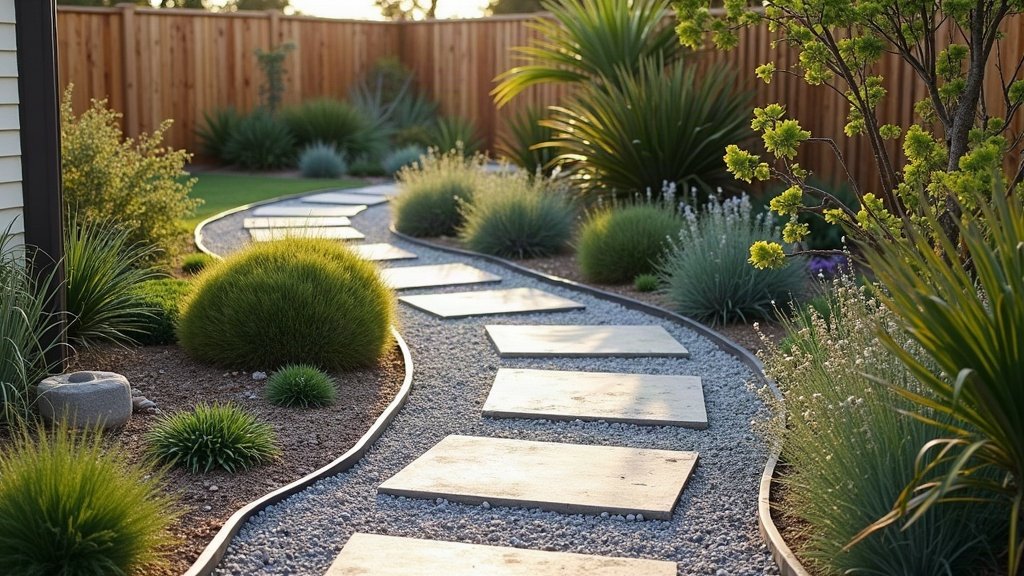
Garden Paths: Gravel, Stepping Stones and Pavers for Getting Around the Yard
The best garden path follows the line people already walk. Before you pick gravel, stepping stones or pavers, look for the worn track in the lawn between the back door, the clothesline, the bins and the veggie patch. That track is your route. The material comes second, and it should suit how often the path is used and what has to roll along it.
Where should a garden path actually go?
Put it where feet and wheels already go, then tidy the line. People cut corners, so a path with a fussy curve gets ignored and the lawn beside it wears bare. A gentle bend around a tree or garden bed is fine. A wiggle for the sake of it isn’t.
Walk the route a few times with a hose or a can of marking paint and lay out the edges on the ground. Push the wheelbarrow along it. Wheel the bins out. If it feels tight, it is. Main routes need room for a barrow and a person carrying something, while a side path into a garden bed can be narrow and casual.
Also think about night use. If the path leads to the bins or a shed you visit after dark, plan for low path lighting now, before the surface goes down.
Gravel, stepping stones, pavers or decomposed granite?
Gravel
Gravel is quick to lay, drains freely and has that satisfying crunch. It suits informal gardens and wide routes. The downsides: it travels on shoes, it’s hard work for a wheelbarrow and a pram, and loose stones end up in the lawn and the mower. Rounded pebbles roll underfoot. Crushed, angular gravel locks together better and is easier to walk on.
Stepping stones
Stepping stones work for light traffic: a route across the lawn to the clothesline, or a path through a garden bed for picking and weeding. They’re cheap to add and easy to lift and reset. Set them to your natural stride, not to a neat measurement, or every trip turns into a shuffle. Sit them flush with the lawn so the mower can run straight over.
Pavers
Pavers give the firmest, most even surface. That makes them the pick for the main route from the house, anywhere a barrow or bins roll, and for anyone unsteady on their feet. They cost more and take more work to lay, because the base has to be dug, compacted and screeded properly. Skimp on the base and they rock and sink. If you’re weighing hard surfaces up for a bigger area as well, our guide to pavers vs decking for an entertaining area covers the trade-offs.
Decomposed granite
Decomposed granite, or DG, is a fine crushed granite that packs down into a firm, natural-looking surface. It feels softer than pavers, costs less, and suits native and cottage-style gardens. It can soften and wash out where water runs across it, and it tracks indoors on wet shoes. A stabilised DG product binds harder, so ask your landscape supplier what they stock and how it should be laid.
How do you keep gravel where it belongs?
With edging. Without a firm edge, gravel and DG creep into the lawn and the garden beds, and the path loses its shape. Steel, timber, brick or concrete edges all do the job. Steel gives a crisp, thin line. Treated timber is cheaper but won’t last as long in the ground. Set the edging slightly proud of the surface so the stones stay in. There’s more on the options in our garden edging guide.
Weeds are the other battle. A layer of permeable weed mat under gravel slows them down, and so does a good compacted base. Nothing stops seeds blowing in and sprouting on top, so expect to pull a few each season.
Why drainage under a path matters
Water decides how long a path lasts. A path that holds puddles goes slippery, grows moss and lifts or sinks over time. Pavers need a slight fall so water runs off to the side, not back towards the house. Gravel drains straight through, which is why it’s often the better choice across a low, damp patch of yard.
If the path runs through a spot that’s soggy after every downpour, fix the water first. A path won’t cure a drainage problem; it just sits in it. Our piece on backyard drainage solutions walks through the common fixes.
Looking after sandstone stepping stones and pavers
Sandstone looks great in an Australian garden, but it’s porous. In shady, damp spots it goes green with algae and black with mould, and that’s when it gets slippery. A stiff broom and a regular sweep keep leaf litter off, which helps. Go easy with a pressure washer, because the wrong pressure can damage the stone’s surface.
Once grime is built in, it’s worth getting a specialist stone cleaner. Sealing after cleaning helps protect the stone from moisture and staining. For tiles and pavers around the house and pool, see our guide to cleaning outdoor tiles and pavers.
Quick picks
- Main route from the house: pavers, laid on a proper base with a fall for water.
- Casual path through the garden: crushed gravel or DG, held in with steel or timber edging.
- Across the lawn to the clothesline: stepping stones set to your stride and flush with the grass.
- Damp, low patch: gravel over a free-draining base, after the water problem is sorted.
Whatever you choose, walk the line first. If the path goes where people already want to go, they’ll use it, and the lawn gets a rest.