Patio Heaters and Outdoor Heating Beyond the Fire Pit
If you want the patio warm enough to sit out after dark from May to September, you’ve got three real choices: a portable gas heater, an electric infrared heater, or something built in and plumbed or wired to the house. Gas is the easiest to buy and move around. Electric infrared is the best fit under a roof. A built-in unit costs the most up front but it’s the one you stop thinking about.
A fire pit is great, but it’s a gathering spot on the lawn, not something you run under the pergola while dinner’s on. If you’ve got one (our guide to setting up a backyard fire pit zone safely covers that), a patio heater is usually the second piece of the puzzle.
The quick comparison
| Type | Best spot | Watch out for |
|---|---|---|
| Portable gas (mushroom or pyramid) | Open patios and decks with plenty of air around them | Wind, bottle swaps, and never taking it inside |
| Electric infrared (wall or ceiling mount) | Under a pergola roof, verandah or alfresco ceiling | Needs a suitable power supply, and the bigger units get wired in |
| Built-in gas or hardwired electric | Alfresco areas you use most weeks of the year | Licensed trade work and a higher install cost |
Portable gas heaters: cheap to start, fussy in the wind
The tall mushroom heater on an LPG bottle is what most people picture. You wheel it out, turn the gas on, light it and you’ve got heat inside a few minutes. No trades needed, and it goes wherever the table ends up.
The catch is that gas heaters warm the air around them, and outside that air doesn’t stay put. On a still night they’re fine. When a southerly comes through, the heat blows away and everyone huddles downwind. Keep a spare bottle on hand, because it always runs out halfway through a birthday.
The big one is carbon monoxide. Energy Safe Victoria lists patio heaters alongside barbecues and fire pits as outdoor heaters that release carbon monoxide, and says plainly to never use outdoor heating appliances indoors and never bring outdoor gas appliances inside your home, caravan, car or tent (Energy Safe Victoria, Heating your home with gas). That includes the garage on a cold night. A patio with café blinds dropped on every side is getting close to a room, so roll a side up or switch the heater off.
Electric infrared: the one that works under a roof
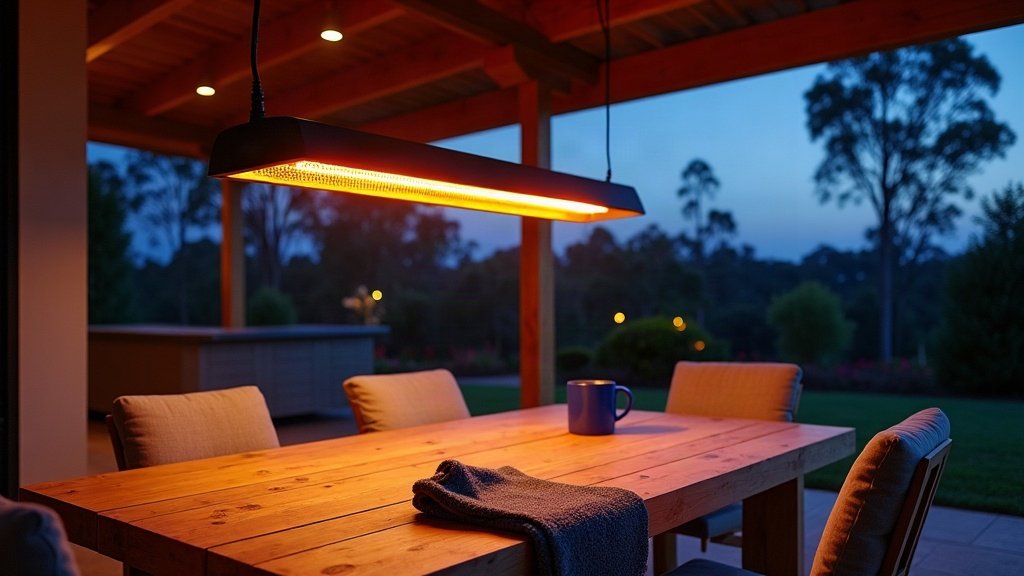
Infrared heaters work differently. Instead of heating the air, they warm the people, the table and the floor they’re pointed at like stepping into the sun. That’s why they hold up better in a breeze, and why they suit a covered area where you wouldn’t want a flame near the ceiling.
- Wall mounted: good for a verandah or alfresco where everyone sits along one side.
- Ceiling or pergola mounted: best over a dining table, pointed down at the chairs rather than the middle of the table.
- Freestanding electric: handy for a small balcony, though you’ll be running a lead to it.
Two things to sort before you buy. First, make sure the unit is rated for outdoor use and for where it’s going, because a heater that’s fine under a solid roof may not be meant for one that cops rain side-on. Second, work out how it’s getting power. A small plug-in unit can run off an outdoor weatherproof power point. The larger ones are usually wired straight in, and that’s electrician territory. Energy Safe Victoria’s position is that electrical work isn’t a DIY job, and that doing unqualified electrical work is illegal as well as dangerous (Energy Safe Victoria, Electrical DDIY). Check your state regulator for local rules.
Built-in heating: worth it if you’re out there every week
If the alfresco is basically a second lounge room, a fixed setup is the grown-up option. That’s either a gas heater run off the house’s natural gas line, or a set of infrared panels wired into the ceiling on their own switch.
Both mean a licensed trade. A gas connection is gasfitter work, and Energy Safe Victoria is clear that gas work is not a DIY project. Plan the heating in with the roof if you can. Running cable or gas through a pergola that’s still being framed is a lot easier than chasing it into one that’s already lined and painted. If you’re still deciding on the roof itself, it’s worth reading up on pergolas, patios and verandahs first, since the structure decides which heater makes sense.
Placement mistakes that waste the heat
Most heaters that “don’t work” are just in the wrong spot:
- Too high: an infrared panel mounted right up in a high-pitched roof spreads its heat too thin by the time it reaches the chairs.
- Pointed at the wrong thing: aim at where people sit, not at the walkway or the barbecue.
- Too close to the fabric: keep every heater to the clearances in its manual, especially near shade cloth, blinds and cushions.
- No wind break: even infrared does better with one side blocked. Outdoor blinds help here, and our guide to outdoor blinds and shade sails goes through the options.
Looking after it between winters
A gas heater that sits out uncovered through a wet spring tends to rust at the burner and collect spider webs in the gas lines, and then it won’t light properly next May. Before you put it away, disconnect the bottle, store the bottle outside in a ventilated spot, and cover the heater. Something like this zip-up patio heater cover with a storage bag keeps the worst of the rain and UV off a tall gas unit. For a wall-mounted electric heater, wipe it down and check the lead, and anything damaged goes to an electrician.
Pick the heater to suit the space you’ve actually got. Open deck, go gas. Under a roof, go infrared. Out there every week, build it in and let the trades do the connection.
Disclosure: Garden Love is a participant in the Amazon Associates Program and may earn a commission from qualifying purchases made through links on this page.